
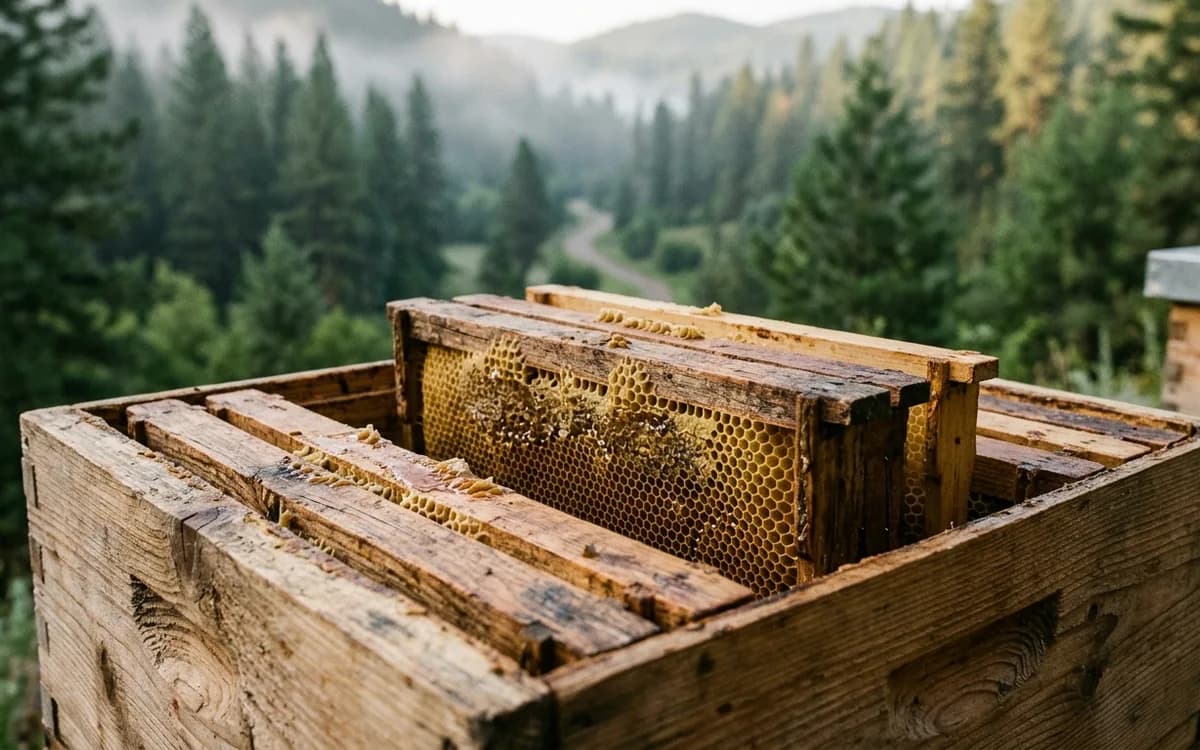
At our Osmaniye Valley field station in Kemalpaşa / Artvin (450–1,100 m · AKS No: 080000845618), a honeybee colony is never a static piece of furniture. Throughout spring swarm prevention, splits, merges, and regional Caucasian queen (Apis mellifera caucasica) replacements, living biological superorganisms move across multiple wooden boxes. Early container-keyed beekeeping tools tied history to the box number—leaving brood records and maternal lineage stranded whenever a colony moved.
SPEC-01 (ColonyOS v3.2) resolves this structural mismatch across 16 relational InnoDB tables organized into 7 bounded contexts. Living colonies (`colonies`) and wooden boxes (`hives`) exist as independent entities joined exclusively through timestamped `hive_occupancies` intervals (`valid_from`, `valid_until`), with relational constraints blocking overlapping box assignments.
Each manual check captures an F01–F10 biological cross-section with explicit ±0.5 frame visual tolerances while `BEFORE UPDATE` and `BEFORE DELETE` triggers on `colony_events` forbid destructive overwrites. Both dual-layer SVG maternal queen graphs (DAG) and chestnut-honey harvest lot traceability remain unbroken across seasons.